1. Introduction
This paper addresses a fundamental gap in blockchain security: the lack of concrete, non-asymptotic security bounds for proof-of-work (PoW) based consensus, particularly for non-sequential variants. While Bitcoin's Nakamoto consensus has been analyzed asymptotically, its probabilistic nature leaves users uncertain about finality. Recent work by Li et al. (AFT '21) provided concrete bounds for sequential PoW. This work extends that rigor to parallel proof-of-work, proposing a new family of state replication protocols (Ak) that use k independent puzzles per block instead of a single chain.
The core promise is enabling single-block finality with quantifiable, extremely low failure probabilities, directly mitigating double-spending risks that plague systems like Bitcoin.
2. Core Concepts & Background
2.1 Sequential vs. Parallel Proof-of-Work
Sequential PoW (Bitcoin): Each block contains one puzzle solution that cryptographically references exactly one previous block, forming a linear chain. Security relies on the "longest chain" rule and waiting for multiple confirmations (e.g., 6 blocks).
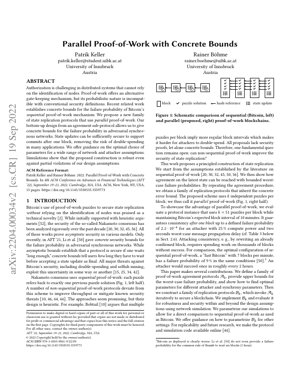
Parallel PoW (Proposed): Each block contains k independent puzzle solutions. These solutions are aggregated to form a block, creating a structure where multiple proof-of-work threads contribute to a single state update (see Fig. 1 in the PDF). This design aims to provide more regular block arrival times and denser proof-of-work per unit time.
2.2 The Need for Concrete Security Bounds
Asymptotic security proofs (e.g., "secure for sufficiently large n") are insufficient for real-world deployment. They don't tell users how long to wait or what the exact risk is. Concrete bounds provide a worst-case failure probability (e.g., $2.2 \times 10^{-4}$) given specific network parameters (delay $\Delta$) and attacker power ($\beta$). This is critical for financial applications requiring precise risk management.
3. The Proposed Protocol: Ak
3.1 Protocol Design & Agreement Sub-Protocol
The protocol family Ak is constructed bottom-up from a core agreement sub-protocol. This sub-protocol allows honest nodes to agree on the current state with a bounded probability of failure. By repeating this agreement procedure, a full state replication protocol is built that inherits the concrete error bound.
Key Design Principle: Use k independent puzzles to generate a block. This increases the "work density" per block interval, making it statistically harder for an attacker to secretly create a competing chain of equal weight.
3.2 Parameter Selection & Optimization
The paper provides guidance for choosing optimal parameters (primarily k and puzzle difficulty) for a wide range of assumptions:
- Network Synchrony: Worst-case message propagation delay ($\Delta$).
- Adversarial Power: Fraction of total hash rate controlled by the attacker ($\beta$).
- Target Security Level: Desired upper bound on failure probability ($\epsilon$).
- Throughput/Latency Goals: Expected block time.
For example, to maintain Bitcoin's 10-minute expected block time but with much higher security, one might choose k=51 puzzles per block, with each puzzle being correspondingly easier to solve.
4. Security Analysis & Concrete Bounds
4.1 Failure Probability Upper Bounds
The primary theoretical contribution is deriving upper bounds for the worst-case failure probability of protocol Ak. Failure is defined as a violation of safety (e.g., a double-spend) or liveness. The bounds are expressed as a function of $k$, $\beta$, $\Delta$, and the puzzle difficulty parameter.
The analysis likely builds on and extends the "private attack" and "balancing attack" models used for sequential PoW, adapting them to the parallel setting where the attacker must solve multiple puzzles in parallel to compete.
4.2 Comparison with Sequential PoW (Bitcoin)
Security Comparison: Parallel PoW (k=51) vs. "Fast Bitcoin"
Scenario: Attacker with 25% hash rate ($\beta=0.25$), network delay $\Delta=2s$.
- Parallel PoW (Proposed): Failure probability for consistency after 1 block ≈ $2.2 \times 10^{-4}$.
- Sequential PoW ("Fast Bitcoin" at 7 blocks/min): Failure probability after 1 block ≈ 9%.
Interpretation: An attacker would succeed in double-spending roughly once every 2 hours against fast Bitcoin, but would need to spend work on "thousands of blocks without success" against the parallel protocol.
5. Experimental Results & Simulation
The paper includes simulations to validate the theoretical bounds and test robustness.
- Validation of Bounds: Simulations under the model's assumptions confirm the derived concrete bounds hold.
- Robustness Testing: Simulations under partial violations of design assumptions (e.g., imperfect synchrony, slightly different adversarial behavior) show the proposed construction remains robust. This is crucial for real-world deployment where ideal models rarely hold perfectly.
- Chart Description (Implied): A key chart would likely plot Failure Probability (log scale) against Attacker Hash Power ($\beta$) for different values of k. This chart would show a steep, exponential-like decline in failure probability as k increases, especially for moderate $\beta$, visually demonstrating the security advantage over sequential PoW (a single line for k=1).
6. Technical Details & Mathematical Framework
The security analysis hinges on probabilistic modeling of the PoW race. Let:
- $\lambda_h$: The rate at which the honest collective solves puzzles.
- $\lambda_a = \beta \lambda_h$: The rate at which the attacker solves puzzles.
- $k$: Number of puzzles per block.
- $\Delta$: Network delay bound.
The core of the bound derivation involves analyzing a binomial or Poisson process race between the honest network and the attacker. The probability that the attacker can secretly solve k puzzles (to create a competing block) before the honest network solves a sufficient number across its nodes is bounded using tail inequalities (e.g., Chernoff bounds). The parallel structure turns the problem into one of the attacker needing k successes before the honest network achieves a certain lead, which for large k becomes exponentially unlikely if $\beta < 0.5$. A simplified conceptual bound might look like:
$$P_{\text{fail}} \leq \exp(-k \cdot f(\beta, \Delta \lambda_h))$$
where $f$ is a function capturing the advantage of honest nodes. This demonstrates the exponential security improvement with k.
7. Analysis Framework: Core Insight & Logical Flow
Core Insight: The paper's breakthrough isn't just parallel puzzles—it's the quantifiable certainty it buys. While others (e.g., Bobtail) heuristically argued parallel PoW improves security, this work is the first to mathematically pin down the exact trade-off between parallelism (k), work rate, and finality time. It transforms security from a "wait and hope" game into an engineering parameter.
Logical Flow:
- Problem: Sequential PoW (Bitcoin) has unbounded, probabilistic finality. Asymptotic bounds are useless for practitioners.
- Observation: Parallelizing work within a block increases the statistical "stiffness" of the chain, making it harder to overtake secretly.
- Mechanism Design: Construct a minimal agreement sub-protocol (Ak) that leverages this stiffness. Its security is analyzable in the synchronous model.
- Mathematization: Derive concrete, calculable upper bounds for the failure probability of Ak.
- Protocol Instantiation: Repeat Ak to build a full blockchain. The security bound carries over.
- Optimization & Validation: Provide a methodology for choosing k and difficulty, and simulate to show robustness.
This flow mirrors rigorous security engineering seen in traditional distributed systems (e.g., the Paxos family), now applied to permissionless consensus.
8. Strengths, Flaws & Actionable Insights
Strengths:
- Concrete Security: This is the crown jewel. It enables risk-adjusted deployment. A payment gateway can now say, "We accept transactions after 1 block because the double-spend risk is precisely 0.022%, which is lower than our credit card fraud rate."
- Single-Block Finality Potential: Dramatically reduces settlement latency for high-value transactions, a key bottleneck for blockchain adoption in finance.
- Parameterized Design: Offers a tunable knob (k) to trade off between security, throughput, and decentralization (as easier puzzles may lower mining barriers).
- Rigorous Foundation: Builds directly on the established synchronous model of Pass et al. and the concrete bounds work of Li et al., giving it academic credibility.
Flaws & Critical Questions:
- Synchronous Model Crutch: The entire analysis rests on a known $\Delta$. In the real world (the internet), $\Delta$ is a probabilistic variable, not a bound. The simulation's "robustness" to assumption violations is reassuring but not a proof. This is a fundamental tension in all synchronous blockchain proofs.
- Communication Overhead: Aggregating k solutions per block increases block size and verification load. For k=51, this is non-trivial. The paper needs a clearer discussion on the scalability of this overhead.
- Miner Strategy & Centralization: Does parallel PoW alter mining game theory? Could it encourage pooling (as seen in Bitcoin) in new ways? The analysis assumes honest majority following protocol—a standard but often violated assumption.
- Comparison Baseline: Contrasting with a "fast Bitcoin" (7 blocks/min) is slightly unfair. A fairer comparison might be against sequential PoW with the same total hash rate per unit time. However, their point about finality speed stands.
Actionable Insights:
- For Protocol Designers: This is a blueprint. The Ak family should be the starting point for any new PoW chain needing fast finality, especially in controlled environments (e.g., consortium chains) where $\Delta$ can be reasonably bounded.
- For Enterprises: Stop using "6 confirmations" as a mantra. Use this framework to calculate your own confirmation depth based on your risk tolerance, estimated attacker power, and network latency.
- For Researchers: The biggest open question is bridging to partial synchrony or asynchrony. Can similar concrete bounds be derived in these more realistic models? Also, explore hybrid designs combining parallel PoW with other finality gadgets (like Ethereum's Casper).
- Critical Next Step: Implement this in a testnet (like a fork of Bitcoin Core) and stress-test it under real-world network conditions. The theory is promising; now it needs battle scars.
9. Future Applications & Research Directions
- High-Frequency Trading (HFT) Settlements: Blockchain-based HFT requires sub-second finality with near-zero risk. A tuned parallel PoW chain in a low-latency, managed network could be a viable solution.
- Central Bank Digital Currencies (CBDCs): For wholesale CBDCs, where participants are known and network conditions can be managed, parallel PoW offers a transparent, audit-friendly consensus with quantifiable settlement risk.
- Cross-Chain Bridges & Oracles: These critical infrastructure components require extremely high security for state finality. A parallel PoW sidechain dedicated to bridge consensus could provide stronger guarantees than many current designs.
- Convergence with Proof-of-Stake (PoS): Research could explore "parallelizable" versions of PoS or hybrid models where security is derived from multiple independent validator committees per slot, analogous to multiple puzzles per block.
- Post-Quantum Considerations: While PoW is inherently post-quantum resistant (for finding, not verifying), the structure of parallel puzzles may offer additional resilience against quantum adversaries by requiring parallel attacks on multiple independent cryptographic problems.
10. References
- Keller, P., & Böhme, R. (2022). Parallel Proof-of-Work with Concrete Bounds. In Proceedings of the 4th ACM Conference on Advances in Financial Technologies (AFT '22).
- Nakamoto, S. (2008). Bitcoin: A Peer-to-Peer Electronic Cash System.
- Li, J., et al. (2021). Bitcoin Security in the Synchronous Model: A Concrete Analysis. In Proceedings of AFT '21.
- Pass, R., Seeman, L., & Shelat, A. (2017). Analysis of the Blockchain Protocol in Asynchronous Networks. In EUROCRYPT.
- Garay, J., Kiayias, A., & Leonardos, N. (2015). The Bitcoin Backbone Protocol: Analysis and Applications. In EUROCRYPT.
- Bobtail: A Proof-of-Work Protocol that Achieves a Target Block Time and Lower Transaction Confirmation Times (Whitepaper).
- Buterin, V., & Griffith, V. (2019). Casper the Friendly Finality Gadget. arXiv preprint arXiv:1710.09437.
- Lamport, L. (1998). The Part-Time Parliament. ACM Transactions on Computer Systems.